


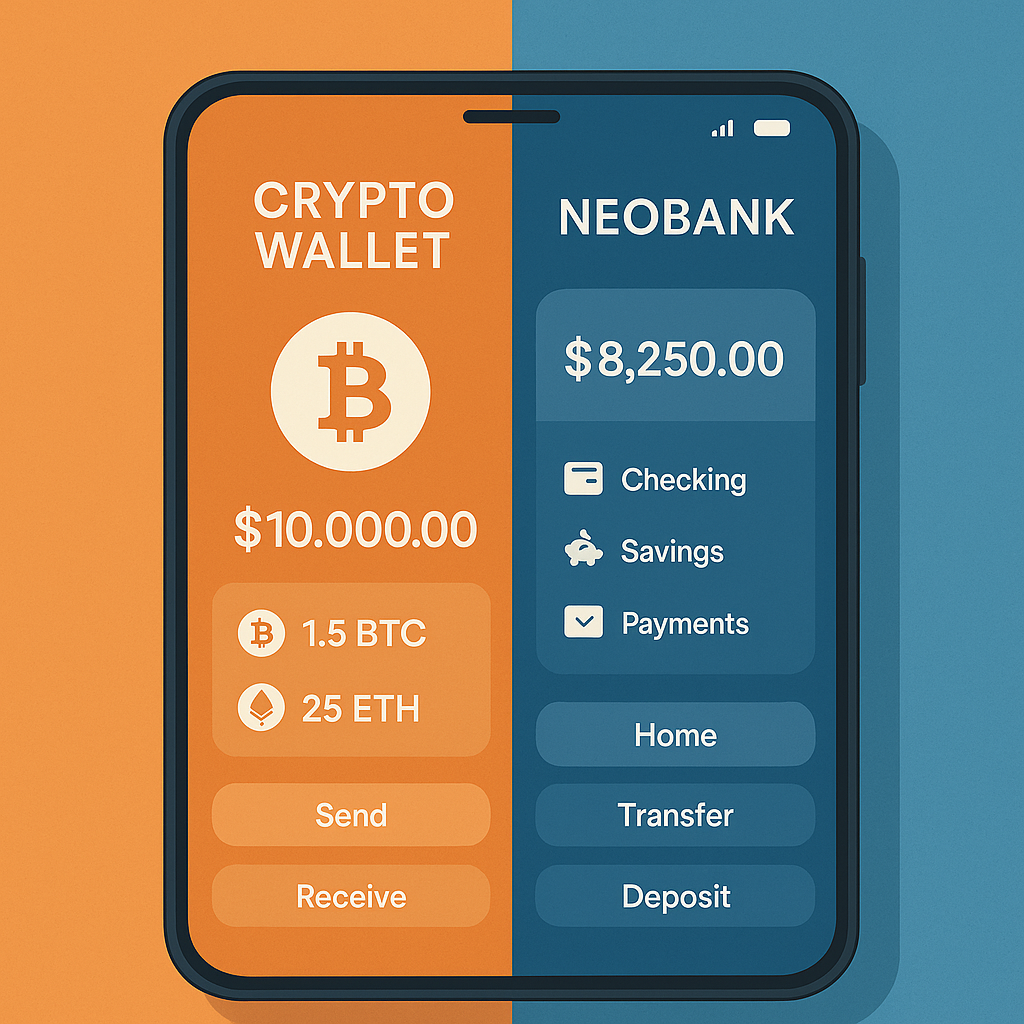
In today’s fast-changing financial landscape, both crypto wallets vs. neobanks are redefining how people store, move, and manage their money. While they may seem similar at first glance — both operate primarily online, both promise low-cost financial services, and both target the digitally savvy — they serve fundamentally different purposes.
As 2025 unfolds, the competition between these two financial tools is intensifying. However, the question remains: Are they rivals fighting for the same users, or are they complementary parts of the future of money management?
Defining the Players
A crypto wallet is a digital tool that allows users to store, send, and receive cryptocurrencies. It can be custodial (managed by an exchange or service provider) or non-custodial (fully controlled by the user). Some wallets also integrate features like staking, token swaps, and decentralized app (dApp) access, making them essential for anyone participating in the blockchain economy.
In contrast, a neobank is a fully digital bank that offers traditional financial services — payments, transfers, savings, and sometimes lending — without a physical branch network. These banks run on modern fintech infrastructure and are often licensed directly or operate via partnerships with licensed banks.
Core Functional Differences
While both provide digital financial access, their core functionalities diverge sharply.
-
Crypto Wallets: Primarily focus on holding and transacting in digital assets like Bitcoin, Ethereum, and stablecoins. They give users access to the blockchain, decentralized finance (DeFi) platforms, and crypto trading.
-
Neobanks: Operate in fiat currency and provide features such as debit cards, bill payments, and budgeting tools. Their value lies in low fees, high-speed transactions, and a better user experience compared to legacy banks.
In essence, one is rooted in decentralized finance, while the other remains a player in the regulated, centralized banking system.
User Experience and Accessibility
From a user’s perspective, the experience differs significantly. Neobanks often mirror traditional bank apps but with sleek interfaces and more transparent fees. They are also bound by strict compliance rules, which means they provide predictable protections for customers.
Crypto wallets, especially non-custodial ones, offer more freedom but also more responsibility. Users must manage their private keys and be aware of blockchain transaction fees, security risks, and market volatility.
Regulatory Landscape
One of the most critical differences lies in regulation. Neobanks operate under banking licenses and are fully integrated into national and international regulatory systems. They must comply with KYC, AML, and CTF rules to operate legally.
Crypto wallets, depending on their type, may not always require identity verification. While custodial wallets offered by exchanges are increasingly regulated, non-custodial wallets often fall outside traditional oversight. This regulatory gap is both a draw for privacy-focused users and a challenge for compliance authorities.
The Competition for Users
Despite these differences, both models often target similar demographics — digitally native, mobile-first users who prioritize convenience, speed, and innovation. However, the competition is more nuanced:
-
Crypto wallets appeal to those seeking alternative assets, privacy, and access to DeFi opportunities.
-
Neobanks attract users looking for modern banking services without the friction of traditional institutions.
Interestingly, hybrid models are emerging. Some neobanks are integrating crypto wallet functionality, while some crypto platforms are offering fiat accounts, blurring the lines between the two.
Strengths and Weaknesses Side by Side
Here’s a quick comparative breakdown:
Crypto Wallets
-
Direct control over digital assets
-
Access to global, borderless transactions
-
Potential to participate in DeFi and earn yields
-
Volatility risk and lack of insurance in most cases
-
Requires technical knowledge for security
Neobanks
-
Regulated and insured deposits
-
Familiar banking services with lower fees
-
Easy integration with payments, payroll, and transfers
-
Limited or no crypto integration in most cases
-
Restricted by geographic licensing
Which One Is Winning in 2025?
The answer depends on how you define “winning.”
-
In user trust and adoption, neobanks still lead. Their compliance with banking regulations makes them more approachable for the average consumer.
-
In innovation and financial freedom, crypto wallets are ahead. They are gateways to the decentralized world, where opportunities extend beyond traditional financial products.
The real “win” may not be in one defeating the other, but in the convergence of both. Fintech firms are beginning to offer multi-asset platforms where users can hold both fiat and crypto, switch between them instantly, and use either for payments.
The Future: Integration Over Competition
Rather than being direct competitors, crypto wallets and neobanks may evolve into integrated services. We could see:
-
Neobanks offering built-in crypto custody alongside fiat accounts.
-
Crypto wallet providers adding regulated fiat gateways for seamless conversion and spending.
-
A shift towards superapps that combine DeFi, traditional banking, payments, and investments in one platform.
If this happens, the future of money management will be less about “crypto wallet vs. neobank” and more about choice, flexibility, and global accessibility.