


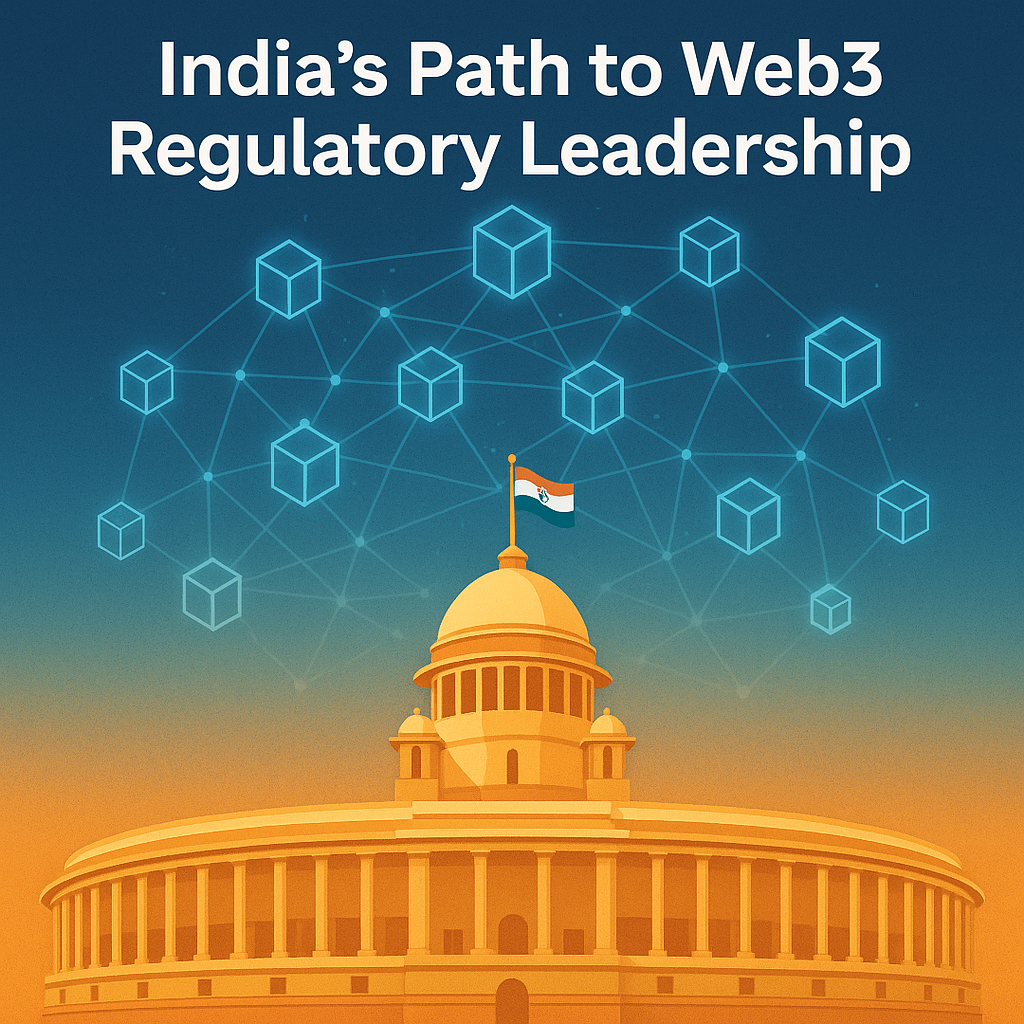
India’s digital ecosystem has seen exponential growth over the past decade, evolving from a cash-driven economy into one of the world’s most vibrant digital payment markets. As the world shifts toward the decentralized era of Web3—powered by blockchain, decentralized finance (DeFi), and virtual digital assets (VDAs)—India finds itself in a unique position to lead. But to truly seize this opportunity, Web3 regulatory leadership must become a national priority—not just to enable innovation, but to shape global standards.
From Policy Hesitancy to Strategic Vision
Just two years ago, India’s stance on digital assets was filled with uncertainty. Regulatory debates often leaned toward extremes—either banning crypto entirely or leaving the space completely unregulated. However, that fragmented approach is evolving.
The introduction of a 30% tax on crypto profits, a 1% TDS on transactions, and compliance requirements under the Prevention of Money Laundering Act (PMLA) in 2023 marked a shift toward formalization. While tough, these moves gave crypto legitimacy within India’s financial framework. Furthermore, during its G20 presidency, India played a pivotal role in pushing the Financial Stability Board (FSB) and the International Monetary Fund (IMF) to publish a global regulatory framework, reinforcing its leadership ambitions.
India Is Uniquely Positioned to Lead the Global Web3 Transformation
India is rapidly emerging as the world’s largest hub for Web3 developers. As of 2024, Indian developers accounted for 17% of all new Web3 contributors on GitHub—with over 4.7 million developers, most of them under 27 years old. These developers are building across critical Web3 verticals including gaming, NFTs, DeFi, and tokenized real-world assets (RWAs).
Moreover, India ranks third globally in the number of Web3 startup founders, boasting over 1,200 active startups. In 2024 alone, Web3 funding in India grew by over 109% year-on-year, crossing $564 million. Emerging tech hubs like Bengaluru continue to attract global capital and engineering talent, especially in areas such as AI-integrated blockchain solutions, staking infrastructure, and tokenized RWA platforms.
This surge in talent and investment gives India not just the capacity—but the responsibility—to shape Web3 standards globally.
Building a Balanced and Progressive Regulatory Framework
India’s ability to lead in Web3 depends on how effectively it creates a regulatory environment that encourages innovation while protecting consumers and financial stability. To achieve this, India must:
-
Recognize VDAs as a separate asset class: Instead of treating crypto like gambling or securities, a dedicated classification will enable more targeted oversight.
-
Rationalize taxation: The current 30% tax rate and 1% TDS discourage participation and push entrepreneurs offshore. A friendlier tax regime can drive capital formation within India.
-
Support industry-led SROs: Empowering self-regulatory organizations will promote best practices, compliance, and investor trust without overburdening regulators.
-
Align with global norms: By harmonizing with frameworks like those from the FATF and FSB, India ensures smooth cross-border engagement and sets the tone for international cooperation.
Leading in Stablecoins, Tokenization, and CBDCs
India also stands at the forefront of three major Web3 breakthroughs:
-
Stablecoins: A rupee-backed stablecoin can redefine cross-border payments, simplify remittances, and reduce FX conversion costs.
-
Tokenization: From real estate to carbon credits, tokenizing real-world assets increases efficiency, liquidity, and transparency.
-
CBDC: With pilots for the Digital Rupee already underway, India can leap ahead in central bank digital currency development if it integrates with programmable smart contracts and Web3 wallets.
India’s Global Leadership Moment Is Now
India has the digital infrastructure, talent, and entrepreneurial firepower to lead the Web3 revolution. Countries like Singapore, the UAE, and the EU have already rolled out progressive digital asset policies. If India wishes to attract capital, anchor innovation, and define the global Web3 rulebook, it must act now.
By embracing Web3 regulatory leadership—not regulating to limit, but to empower—India can shape the future of finance, governance, and digital identity. The next five years will determine the global leaders of Web3, and India has all the right ingredients to rise to the top.