


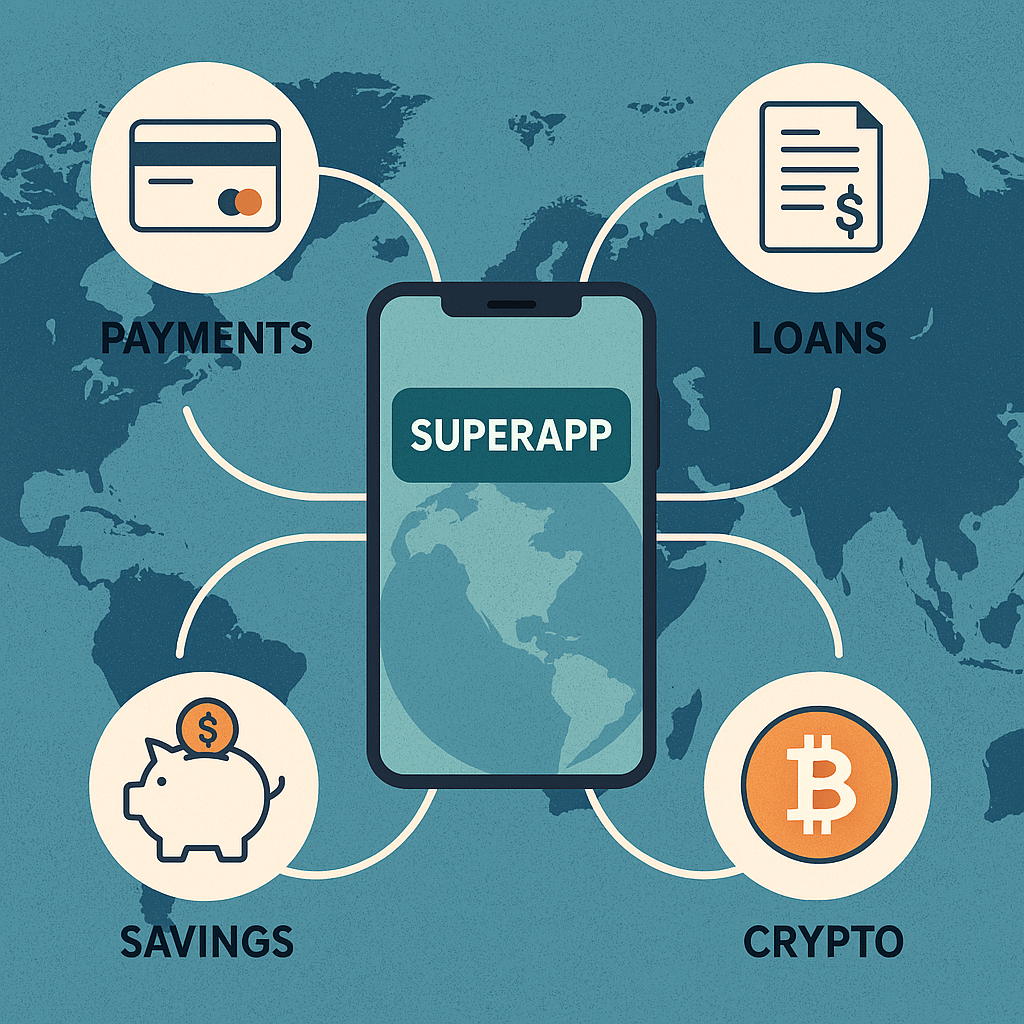
The Rise of Fintech Superapps
In the last decade, the term “superapp” has emerged as a powerful concept—especially in Asia, where platforms like WeChat, Alipay, and Gojek dominate the digital landscape. These applications offer a single interface for a wide range of services: payments, shopping, loans, ride-hailing, insurance, and more. Now, as global fintech players look to replicate this success, a critical question arises: Can fintech superapps truly go global, or will their power remain tied to local contexts?
At the heart of this discussion lies a balance between hyper-local user expectations and the global scalability of infrastructure. While some platforms dream of cross-border dominance, real-world constraints—like regulation, culture, and competition—force many fintech superapps to stay regional.
But the global race is heating up. With players from Latin America to Africa trying to emulate Asia’s success, it’s worth examining the key enablers—and obstacles—facing superapp expansion.
What Defines a Fintech Superapp?
A fintech superapp is more than a digital wallet. It’s an integrated ecosystem that brings together financial and non-financial services under a unified user experience. These apps are designed not just to retain users, but to become indispensable in daily life.
Common features include:
-
Digital wallets and instant transfers
-
Micro-loans and BNPL (Buy Now, Pay Later) options
-
Investment tools (crypto, stocks, mutual funds)
-
Insurance, savings, and pension products
-
E-commerce and lifestyle integrations (travel, food delivery, etc.)
Importantly, fintech superapps aim to eliminate app-switching by centralizing the user’s entire financial life.
Why Asia Leads the Superapp Surge
Asia’s dominance in this space is no accident. Countries like China and Indonesia provided the perfect environment: high mobile penetration, low traditional banking access, and tech-savvy populations. Moreover, regulatory frameworks allowed more experimentation early on, letting players like Tencent and Grab shape the market.
In these regions, fintech superapps didn’t just fill gaps—they became infrastructure.
However, replicating this success elsewhere requires a nuanced understanding of local dynamics. Even though the architecture might be scalable, user behavior is not always transferable.
Can Fintech Superapps Scale Globally?
While the opportunity for global expansion exists, several challenges stand in the way. Let’s break down both sides of the debate:
🔹 Why Global Expansion Is Hard
-
Regulatory Fragmentation: Financial services are tightly regulated. A superapp that complies with the rules in Singapore might struggle to adapt in Brazil or Nigeria.
-
Cultural Contexts: Payment behaviors, trust in digital platforms, and financial literacy levels vary widely across regions.
-
Localized Competition: Regional players often dominate with deep user knowledge and regulatory relationships.
-
Data and Privacy Laws: Differing rules on data storage and sharing (e.g., GDPR in Europe vs. data sovereignty laws in India) complicate operations.
🔹 Why It’s Still Possible
-
Cloud-Native Infrastructure: Modern superapps are being built using modular APIs and cloud platforms, enabling easier expansion and localization.
-
Rising Cross-Border Demand: Migrants, freelancers, and remote workers increasingly need global financial services.
-
Global VC Backing: Investors are pushing fintechs to grow beyond borders—often via partnerships or M&A.
Ultimately, while it’s harder to globalize than it appears, fintech superapps aren’t starting from scratch. Their growth models just need to evolve.
Emerging Models of Expansion
Rather than simply replicating the models of WeChat or Alipay, emerging fintech superapps are embracing more nuanced and flexible approaches. Some are forging strategic partnerships with telecom providers, banks, or retail networks to rapidly establish a local footprint. Others are offering white-label infrastructure, as seen with platforms like M-Pesa and Paytm, enabling localized services to be built on their backbones.
Additionally, certain players are prioritizing compliance from the outset—embedding regulatory frameworks into their products to expedite approvals in new markets. These approaches highlight a key insight: global success doesn’t demand a one-size-fits-all product. In fact, the fintech superapps most likely to thrive globally may be those that continually adapt to local needs and dynamics, scaling by thinking locally at every step.
Case Studies: Global Aspirations in Motion
Several fintech players are already attempting to scale superapp models globally:
-
Revolut (UK): Started as a neo-bank, now offering crypto trading, travel insurance, budgeting tools—and expanding across Europe, the U.S., and APAC.
-
Toss (South Korea): From payments to investments to insurance, Toss aims to replicate its model across Southeast Asia.
-
Kuda (Nigeria): With its eye on the African diaspora, Kuda is building an inclusive superapp for underbanked populations.
These platforms are not just exporting products—they’re adapting to local realities while preserving their core DNA.
What the Future Holds for Fintech Superapps
So, will fintech superapps go global or remain regional? The most realistic answer likely lies somewhere in between. It’s becoming increasingly evident that a single superapp brand or interface won’t dominate the global stage. Instead, the future points toward modular design, interoperability, and ecosystem-driven strategies.
We’re already seeing the rise of “superapp-as-a-platform” models, which let third-party providers plug into core services. At the same time, regulatory-compliant micro-superapps are emerging, tailored to specific verticals or user groups. Additionally, open APIs are enabling local businesses to innovate on top of shared infrastructure, offering a more inclusive and competitive alternative to platform monopolies
Strategic Takeaways for Fintech Leaders
To lead in the next wave of fintech superapps, businesses must:
-
Design for modularity: Build systems that scale horizontally across markets while localizing features vertically.
-
Invest in compliance early: Work with regulators—not against them—when entering new regions.
-
Localize user experience: Hire locally, research locally, and adapt relentlessly.
-
Prioritize trust: In every market, trust is the true currency. Security, transparency, and customer service will make or break adoption.
Conclusion: A Global Dream with Local Realities
Fintech superapps are not just a product trend—they represent a fundamental shift in how financial services are built and consumed. The idea of a single app solving all financial needs is powerful, but its execution varies by geography.
Rather than ask whether these superapps will go global or stay regional, perhaps the better question is: Can they become global platforms built on regional foundations?
Those who answer “yes” with action—not just ambition—will shape the next decade of financial innovation.