
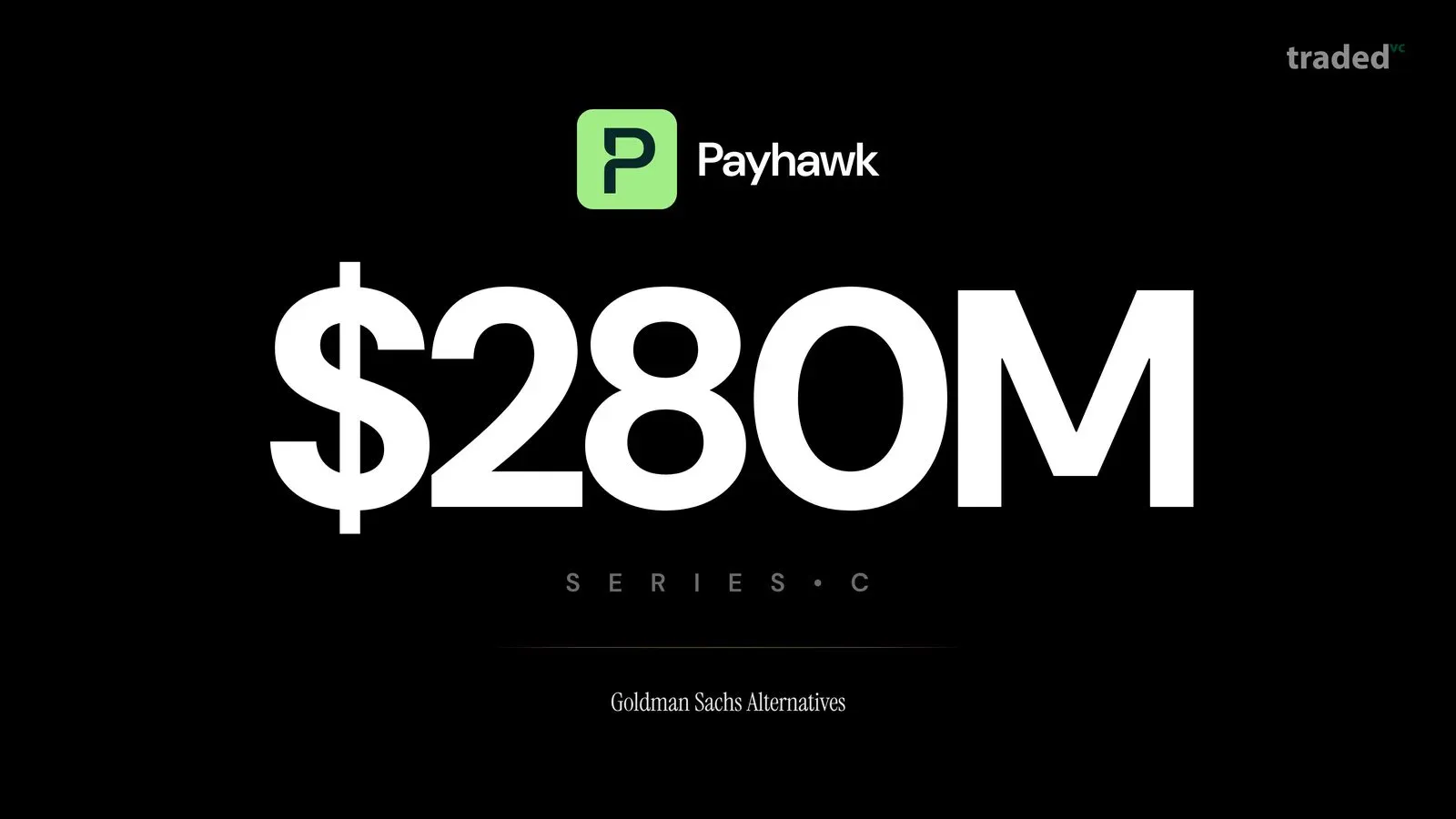
Goldman Sachs Alternatives leads the all-equity Series C as the fintech expands beyond spend management into AI agents, payments infrastructure, and enterprise financial controls.
Payhawk has raised $280 million in a Series C funding round at a $2 billion valuation. Growth Equity at Goldman Sachs Alternatives led the investment, which brings the company's total funding to more than $515 million.
Announced on November 18, 2026, the all-equity transaction includes participation from existing investors QED, Greenoaks, Lightspeed, Hedosophia, and Bek Ventures. New investors include Galdana Ventures, Cogito Capital, Inveready, and Invus. European entrepreneurs Tomas Okmanas and Didac Lee also participated.
The transaction remains subject to standard regulatory approvals.
The funding marks a strategic shift for Payhawk. The company wants to move beyond traditional spend management and build what it calls a global finance operating system for the AI era. Its proposed model brings AI agents, payment infrastructure, and enterprise controls into one connected platform.
The ambition reflects a wider change in financial software. Businesses increasingly expect AI to do more than analyze information or recommend actions. They want systems that can carry out financial work while keeping spending policies and human oversight in place.
Payhawk's $280 Million Funding Supports a Broader Finance Strategy
Payhawk plans to use the new capital to develop its finance operating system and expand its position in global business finance.
Founded in Sofia, Bulgaria, the company operates across 33 countries and 12 offices. Its platform supports businesses working across different currencies, banking systems, payment networks, and regulatory environments.
This international footprint is central to its strategy. Companies with operations in several markets often manage expenses, procurement, payments, and financial reporting through separate systems. As a result, finance teams face fragmented information and manual processes.
Payhawk aims to connect these activities through a unified platform. Rather than treating cards, bills, travel, and procurement as separate tools, it wants to coordinate them through AI agents and shared financial controls.
The company's ambition also reflects a broader opportunity for European fintech firms. Payhawk argues that experience with different banking systems and regulatory environments can help it build financial technology for international businesses.
Three Layers Will Shape Payhawk's AI Finance Operating System
Payhawk is building its proposed operating system around three connected components.
1. AI agents for financial work
The first layer consists of agents designed to perform tasks across financial control, procurement, travel, and reporting.
According to CEO and co-founder Hristo Borisov, 77% of Payhawk's customers use its agents daily. The company says these tools help reduce administrative work and improve financial processes.
Borisov describes the intended outcome as "zero-touch finance." Under this model, employees and finance professionals would spend less time handling routine administration.
However, wider adoption will depend on how reliably these agents perform tasks and how businesses manage exceptions.
2. Payment infrastructure for transactions
The second layer connects AI-driven decisions with the movement of money.
An agent may identify an invoice, prepare a payment, or manage a purchase. However, carrying out that action requires access to payment infrastructure.
This creates a different challenge from using AI to summarize documents or analyze spending. Systems must handle payment credentials, transaction execution, and the movement of funds securely.
Payhawk, therefore, sees payments as a core part of its Finance OS strategy, rather than simply another feature within a spend management platform.
3. Enterprise controls and human oversight
The third layer determines what agents can do and when a person must approve a decision.
Businesses need to enforce spending limits, procurement policies, approval rules, and budget controls. These requirements become more important when software moves from suggesting actions to executing them.
Payhawk wants enterprise controls to operate alongside its AI agents and payment infrastructure. This could help companies automate routine work without removing accountability from their finance teams.
Together, these components form the foundation of the company's proposed operating model.
Why AI Integrations Alone May Not Be Enough
Payhawk believes that adding AI features to individual business applications will not automatically transform corporate finance.
Enterprise resource planning systems, banks, procurement platforms, treasury products, and travel tools are increasingly adopting AI capabilities. Model Context Protocol (MCP) servers can also help AI applications access information and interact with connected systems.
However, connecting applications does not necessarily create a coordinated finance operation.
For example, an AI assistant might identify an invoice and retrieve supplier information. Yet the business still needs a reliable process to verify the invoice, check available budgets, approve the transaction, and complete payment.
This is where Payhawk wants to differentiate its platform.
The company argues that an operating system should coordinate the entire process, rather than simply connect separate applications. Its model places AI agents within a controlled financial environment.
That distinction could become important as businesses give AI systems greater responsibility for operational decisions.
Payhawk Highlights a Business Model Beyond Card Interchange
Another important part of Payhawk's strategy is its subscription-led business model.
The company says its revenue model is based on predictable subscription pricing rather than card interchange. This means its commercial model is not primarily tied to encouraging customers to spend more through its payment cards.
That approach could give Payhawk more flexibility to develop products that work with payment instruments beyond its own cards.
The company points to its financial controller agent in the United States as an example. It can work with customers' existing business cards, reducing the need to switch providers or issue new cards.
Payhawk also reported positive cash flow in the third quarter. It said it still holds 70% of the capital raised in its previous funding round in 2022.
These figures offer insight into its financial position, although they are company-reported metrics rather than independently audited performance disclosures in the funding announcement.
Goldman Sachs Joins Payhawk's Board as Funding Expands Its Reach
The investment also gives Goldman Sachs Alternatives a closer role in Payhawk's next stage of development.
James Hayward, managing director within growth equity at Goldman Sachs Alternatives, is joining Payhawk's board of directors.
Hayward said the convergence of payments, AI, and enterprise software creates an opportunity for Payhawk to become a leading player in the market.
For Goldman Sachs Alternatives, the investment adds to its growth equity activity in technology-driven businesses. For Payhawk, the backing provides additional capital and a major institutional investor as it pursues international expansion.
The $280 million round also places Payhawk's latest valuation at $2 billion. However, its ability to justify that valuation will depend on execution, customer adoption, and the commercial performance of its AI-powered products.
Can Payhawk Turn Spend Management into a Global Finance OS?
The funding arrives as fintech companies increasingly compete to control more of the business finance workflow.
Traditional spend management platforms have focused on corporate cards, expense tracking, invoice processing, and procurement. AI creates an opportunity to connect these functions and automate more of the work between them.
Yet financial automation requires more than capable AI models. It also depends on secure payments, reliable data, clear permissions, and effective oversight.
Payhawk's strategy brings these requirements together in one proposed platform. Its existing international footprint provides a foundation, while the new funding gives it resources to pursue the next stage.
The challenge will be turning that vision into measurable results for businesses operating across different markets.
If Payhawk succeeds, it could help redefine how companies manage financial operations. For now, the Series C marks a major investment in that ambition, rather than proof that a fully autonomous finance operating system has already arrived.
Source note: Based on Payhawk's November 18, 2026 funding announcement and related company information.
Comments
No comments yet. Be the first to share your thoughts.
Leave a comment