
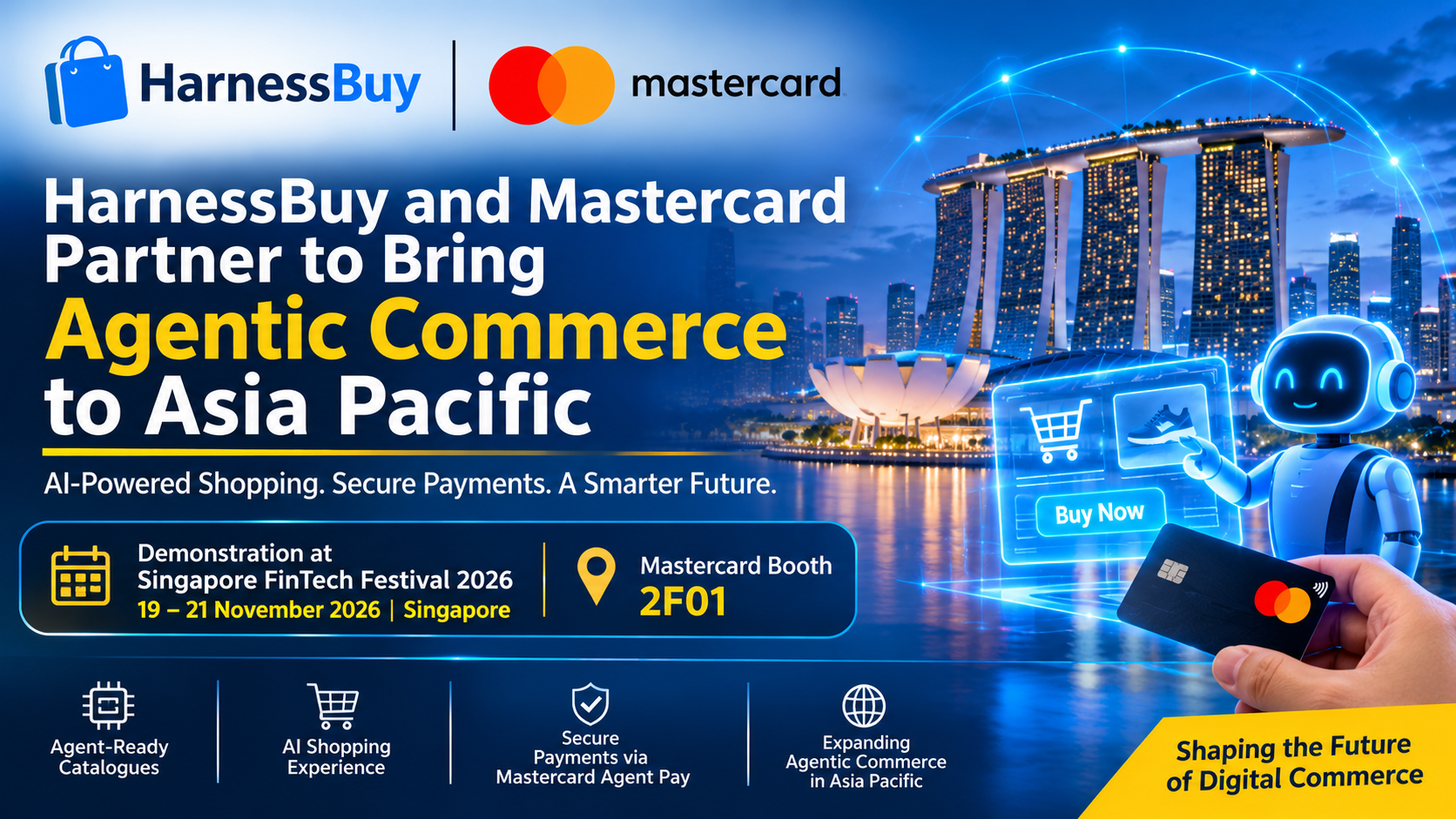
HarnessBuy has signed an MOU with Mastercard to demonstrate AI-led shopping and payments, combining agent-ready product catalogues with Mastercard Agent Pay.
HarnessBuy has signed a memorandum of understanding (MOU) with Mastercard to advance agentic commerce across Asia Pacific. The partnership will explore how AI agents can discover products, compare options, and complete purchases on consumers' behalf.
The announcement, made in Singapore on November 19, 2026, comes as payment networks and technology providers work to make AI-driven transactions more practical and secure.
HarnessBuy plans to demonstrate its agentic commerce platform, integrated with Mastercard Agent Pay, at Singapore FinTech Festival 2026. The demonstration will take place at Mastercard’s booth, number 2F01.
The proposed collaboration brings together two important parts of agentic commerce: making merchant products understandable to AI agents and enabling those agents to complete payments.
HarnessBuy and Mastercard Target the Full Agentic Shopping Journey
Traditional online shopping requires consumers to visit merchant websites, search product listings, and complete checkout themselves. Agentic commerce aims to change that process.
AI agents can potentially handle several steps on a consumer’s behalf. These include finding suitable products, comparing prices, checking availability, and placing orders.
However, this model requires more than a capable shopping assistant. Product information must be accessible to AI systems, while payment infrastructure must support secure and authorized transactions.
HarnessBuy says its platform addresses both requirements through two core capabilities.
Making Merchant Catalogues Ready for AI Agents
The first capability is agentic catalogue enrichment.
HarnessBuy transforms merchants’ existing product catalogues into assets that AI agents can discover, understand, and compare. This could help traditional retailers make their products visible across emerging AI-powered shopping platforms.
Accurate product information will be important as this model develops. Agents need access to relevant details, current prices, and inventory information before recommending or purchasing products.
For merchants, the ability to reuse existing catalogue data could reduce the work involved in preparing for agent-led shopping.
Connecting AI Shopping to Payments
The second capability is integrated agentic payments.
HarnessBuy says its platform enables consumers to purchase and pay directly through shopping agent platforms. It also says merchants can participate without changing their existing storefronts, payment systems, or fulfillment processes.
This approach could lower the technical barriers for retailers that want to explore agentic commerce.
However, the companies have not announced a broad commercial rollout or confirmed which merchants will participate in future pilots.
Mastercard Agent Pay Supports the Payment Layer
The integration with Mastercard Agent Pay is central to the proposed demonstration.
Mastercard has been developing payment capabilities for transactions initiated by AI agents. Its approach focuses on establishing trust, identifying agents, and ensuring that transactions take place with appropriate consumer authorization.
This is an important requirement. An AI agent may be able to select a product and prepare an order, but payment systems must still establish whether it has permission to complete the purchase.
Mastercard has already been expanding its agentic payment activity across Asia Pacific. In March 2026, the company announced its first live authenticated agentic transaction in Singapore with DBS and UOB. The transaction involved an AI agent booking a ride through mobility provider Hoppa.
The wider regional push indicates growing interest in moving agentic commerce beyond product recommendations and into real transactions.
What the HarnessBuy Demonstration Will Show
HarnessBuy says its demonstration combines product discovery, order creation, and payment into one agent-led shopping journey.
The AI agent will be able to:
- Discover products through agent-ready merchant catalogues.
- Access current product information, pricing, and inventory.
- Create an order based on the shopping request.
- Complete payment through the Mastercard Agent Pay integration.
The demonstration is intended to show how an AI agent could manage the journey from product discovery to checkout.
Nevertheless, a demonstration does not establish that the system is ready for unrestricted consumer use. Wider adoption will depend on factors such as merchant participation, transaction security, consumer consent, and integration with existing commerce systems.
Future Pilots and Merchant Participation
Under the MOU, HarnessBuy and Mastercard will explore additional agentic commerce and payment use cases.
They also plan to examine opportunities for broader merchant participation and potential pilots across the region. Further work may connect their platforms, capabilities, and partner ecosystems to support adoption.
Terence Chau, director at HarnessBuy, said merchants need both AI discoverability and secure payment capabilities for agentic commerce to work.
He said the collaboration aims to bring catalogue enrichment and integrated payments to traditional merchants without requiring changes to their existing operations.
The companies have not disclosed a commercial deployment schedule, financial terms, or specific markets for future pilots.
Why Agentic Commerce Matters to the Payments Industry
The shift towards agent-led shopping could change how consumers interact with merchants and payment providers.
Today, most digital payment journeys are built around a human shopper navigating a website or application. Agentic commerce introduces software agents that can make decisions and initiate transactions within consumer-defined instructions.
This creates new requirements for the payments industry. Providers must consider how to identify agents, verify their authority, protect payment credentials, and give consumers visibility over purchases.
It also raises questions about refunds, disputes, accountability, and the handling of inaccurate product information.
For merchants, discoverability could become another important competitive factor. As consumers increasingly use AI tools to research products, retailers may need structured and reliable catalogue data to remain visible.
HarnessBuy's proposed integration with Mastercard addresses parts of this emerging infrastructure. Its progress will depend on whether the demonstration can translate into practical merchant deployments and trusted consumer experiences.
A Step Towards AI-Led Commerce in Asia Pacific
The HarnessBuy-Mastercard MOU reflects a wider industry effort to connect AI shopping agents with established payment networks.
The Singapore FinTech Festival demonstration will offer a practical view of how product discovery, order creation, and payment can work together.
However, the next stage will be more important than the demonstration itself. Merchant adoption, secure authorization, and successful regional pilots will determine whether agentic commerce can move into everyday transactions.
For now, the partnership signals another step in the development of payment infrastructure designed for a future in which AI agents may increasingly shop and transact on consumers’ behalf.
Comments
No comments yet. Be the first to share your thoughts.
Leave a comment