
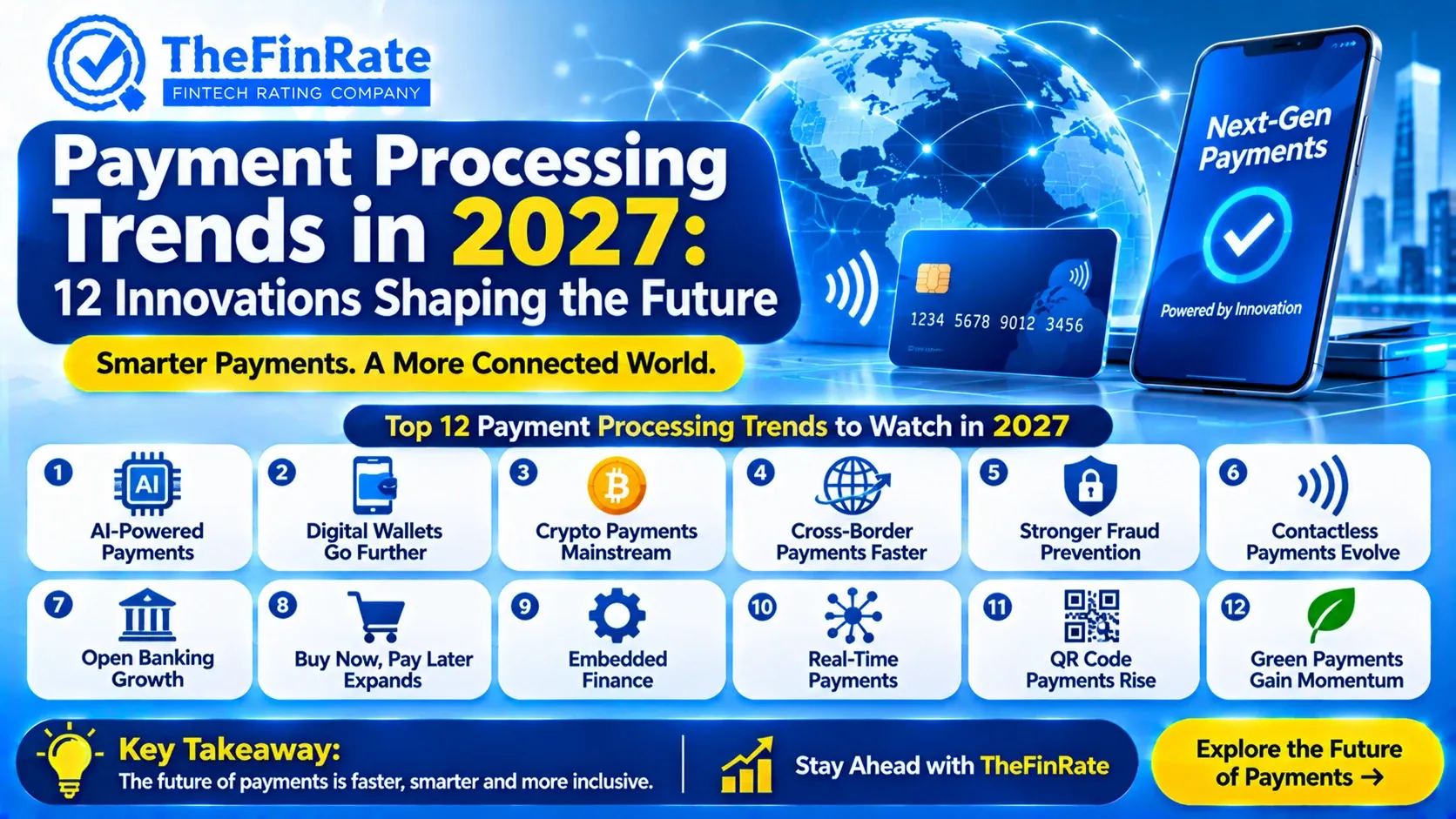
The global payment processing industry is entering a new phase of transformation. Businesses and consumers increasingly expect payments to be faster, safer, more flexible, and available across borders. At the same time, artificial intelligence, digital currencies, real-time payment networks, and financial automation are changing how transactions are initiated, processed, and settled.
As we approach 2027, payment processing is becoming more than a system for transferring money. It is evolving into an intelligent financial infrastructure that connects banks, merchants, fintech companies, payment service providers (PSPs), and digital platforms.
For businesses, keeping up with these developments is important for improving customer experiences, reducing payment friction, managing fraud, and expanding into international markets.
In this guide, we explore 12 payment processing trends in 2027 that could shape the future of digital payments and create new opportunities for businesses and fintech companies.
Why Is Payment Processing Changing in 2027?
Traditional payment systems were designed around card transactions, bank transfers, and established financial networks. However, digital commerce has created demand for more flexible payment experiences.
Customers want instant confirmations, convenient checkout options, and secure transactions. Businesses want faster settlements, lower processing costs, improved fraud prevention, and better visibility into their payments.
Several developments are accelerating this transformation:
- Rapid adoption of artificial intelligence
- Growth of real-time payment infrastructure
- Increasing demand for cross-border transactions
- Expansion of digital wallets and alternative payment methods
- Greater use of tokenization and digital identity
- Modernization of banking and payment infrastructure
- Growing demand for automated business payments
12 Payment Processing Trends in 2027
1. Artificial Intelligence Will Transform Payment Processing
Artificial intelligence is becoming an important part of modern payment infrastructure. Payment providers are increasingly exploring AI to analyze transaction patterns, identify suspicious activity, improve payment routing, and automate operational tasks.
In 2027, AI is expected to play a larger role in helping payment companies make faster and more informed decisions.
For example, an AI-powered payment platform can evaluate transaction information, customer behavior, device signals, and historical activity to identify unusual patterns.
Potential applications include:
- Automated transaction monitoring
- Intelligent payment routing
- Fraud detection and risk scoring
- Customer support automation
- Payment reconciliation
- Transaction analysis and reporting
AI can help payment providers improve operational efficiency, but businesses must also consider model accuracy, data privacy, explainability, and human oversight.
2. Agentic AI and Autonomous Payments Will Emerge
One of the more significant developments to watch in 2027 is agentic commerce.
Agentic AI refers to software systems that can perform tasks and make decisions within permissions defined by a user or business. In payments, an AI agent could eventually search for products, compare prices, select a payment method, and initiate an authorized transaction.
For example, a customer might instruct an AI shopping assistant to purchase a particular product below a specified budget. The assistant could identify suitable products and prepare a transaction for approval.
Businesses may need payment infrastructure that can verify:
- The identity of the AI agent
- The user's authorization
- Spending limits and transaction permissions
- The authenticity of payment instructions
- Transaction records and accountability
Autonomous payments also create new risks. Unauthorized purchases, compromised AI agents, and unclear responsibility could become important challenges.
3. Real-Time Payments Will Become More Important
Customers and businesses increasingly expect money to move quickly. Traditional bank transfers can involve processing windows, intermediary institutions, and settlement delays.
Real-time payment systems are designed to move funds and provide transaction confirmation much faster, often operating continuously rather than only during conventional banking hours.
In 2027, more businesses are expected to explore real-time payment infrastructure for domestic transactions, supplier payments, payroll, and other financial operations.
Examples of real-time payment systems include:
- UPI in India
- FedNow in the United States
- Faster Payments in the United Kingdom
- SEPA Instant Credit Transfer in participating European markets
Benefits for businesses:
- Faster access to funds
- Improved cash flow visibility
- Quicker supplier payments
- Better customer payment experiences
- Reduced dependence on traditional settlement schedules
However, real-time payments also require effective fraud monitoring, transaction verification, and dispute management.
4. Stablecoins and Tokenized Deposits Will Influence Digital Payments
Stablecoins and tokenized deposits are attracting attention as alternative ways to represent and transfer value digitally.
A stablecoin is a digital asset designed to maintain a relatively stable value, often by referencing a currency such as the US dollar. Tokenized deposits represent bank deposits through digital token infrastructure.
Both technologies are being explored for applications such as international settlement, treasury management, and business-to-business payments.
In 2027, their role may expand where regulatory approval, banking partnerships, and reliable infrastructure support commercial adoption.
Potential use cases include:
- Cross-border business settlements
- International supplier payments
- Digital asset transfers
- Treasury operations
- Programmable financial transactions
Stablecoins and tokenized deposits are not interchangeable with ordinary bank transfers. Businesses must evaluate reserve arrangements, redemption rights, custody, counterparty exposure, legal requirements, and regulatory restrictions.
5. Payment Tokenization Will Strengthen Transaction Security
Payment tokenization replaces sensitive payment information, such as a card number, with a substitute value called a token.
This helps reduce the exposure of actual card details during payment processing and storage.
Tokenization is already used in digital wallets, card-on-file transactions, and ecommerce payment systems. Its importance is expected to continue growing as businesses manage more recurring and digital transactions.
Key advantages include:
- Reduced exposure of sensitive card information
- Improved security for stored payment credentials
- Support for recurring payments
- Better protection of customer payment data
- Reduced reliance on directly handling card details
For ecommerce businesses, tokenization can support smoother repeat purchases while helping reduce the risks associated with storing payment credentials.
Businesses should also understand that tokenization does not automatically remove all PCI DSS responsibilities. Security requirements depend on the overall payment environment.
6. Open Banking and Account-to-Account Payments Will Expand
Open banking allows customers to authorize the secure sharing of financial information or initiation of payments through regulated providers and connected financial institutions.
This creates opportunities for account-to-account payments that move money directly between bank accounts without relying exclusively on traditional card networks.
In 2027, open banking-based payment services may become more relevant in markets where regulations and banking infrastructure support them.
Potential benefits include:
- Alternative payment methods for online purchases
- Reduced dependence on card-based transactions
- Better payment visibility
- Account-based payment initiation
- Improved financial data connectivity
For merchants, pay-by-bank options can provide an additional checkout choice. However, adoption depends on customer familiarity, bank coverage, authorization requirements, and the quality of payment confirmation.
7. Payment Orchestration Will Help Businesses Manage Multiple Providers
Businesses operating across different countries often work with several payment gateways, acquiring banks, and alternative payment providers.
Managing these systems independently can increase operational complexity.
Payment orchestration platforms connect multiple payment providers through a unified layer. They can help businesses route transactions, monitor performance, manage integrations, and improve payment operations.
For example, an international ecommerce company may use different providers for domestic card payments, international transactions, and local payment methods.
Important capabilities include:
- Intelligent transaction routing
- Multiple gateway integrations
- Payment performance monitoring
- Centralized reporting
- Retry management
- Payment method optimization
In 2027, orchestration may become increasingly relevant to growing ecommerce businesses, subscription platforms, and international merchants.
8. Embedded Payments Will Become More Common
Embedded payments allow customers to make payments directly within the platforms and applications they already use.
Instead of sending customers to a separate payment website, businesses can integrate payment functionality into their existing customer experience.
Examples include:
- Paying for services inside a mobile application
- Booking and paying for travel through one platform
- Making purchases through business software
- Paying invoices through accounting platforms
- Completing transactions within online marketplaces
Embedded payment experiences can reduce checkout friction and simplify business operations.
However, companies offering embedded payments must consider the responsibilities of their payment partners, licensing requirements, customer protection, data security, and financial compliance.
9. Biometric Authentication and Passkeys Will Improve Payment Security
Traditional authentication methods often rely on passwords and one-time passwords (OTPs). These methods can create friction and may be vulnerable to phishing, credential theft, and social engineering.
Biometric authentication uses characteristics such as fingerprints or facial recognition to verify a user. Passkeys use cryptographic credentials connected to a user's device or authentication environment.
In 2027, these technologies may become more common across supported banking applications, digital wallets, and payment experiences.
Potential advantages include:
- Faster customer authentication
- Reduced dependence on passwords
- Better resistance to phishing
- More convenient payment approval
- Stronger device-based identity verification
Biometric authentication and passkeys are not identical, and neither guarantees complete protection against fraud. Payment providers must implement appropriate recovery, device security, and transaction authorization controls.
10. Cross-Border Payments Will Become More Connected
International payments are essential for global ecommerce, exporters, SaaS companies, freelancers, and multinational businesses.
However, cross-border transactions can involve multiple banks, payment networks, currencies, compliance checks, and intermediary institutions.
The industry is working toward faster, more transparent, and more affordable international transfers.
In 2027, important developments may include:
- Better connections between domestic instant payment networks
- More transparent foreign exchange pricing
- Improved payment tracking
- Wider use of international digital wallets
- Stablecoin and tokenized settlement experiments
- Better payment data interoperability
For businesses, these developments could improve international collections and supplier payments.
11. ISO 20022 Will Support More Structured Payment Data
ISO 20022 is an international financial messaging standard that enables more structured and detailed information to accompany financial transactions.
It is important because traditional payment messages may contain limited or inconsistently formatted information. Structured data can improve how financial institutions process payments, identify beneficiaries, and reconcile transactions.
Its wider adoption can support:
- More detailed remittance information
- Improved payment reconciliation
- Better transaction transparency
- More effective compliance screening
- Greater interoperability between financial institutions
In 2027, organizations will continue adapting systems and workflows to support richer payment information and evolving market requirements.
Businesses that make international payments should work with their banking and payment partners to understand relevant ISO 20022 requirements.
12. Automated B2B Payments and Reconciliation Will Grow
Business-to-business payments often involve invoices, purchase orders, supplier verification, approvals, payment execution, and accounting updates.
Managing these processes manually can create delays and reconciliation problems.
Payment automation connects financial systems and payment infrastructure to reduce repetitive work.
For example, an automated system may match an approved invoice with a supplier record, initiate a payment according to company policy, and update the accounting system after confirmation.
Potential benefits include:
- Faster invoice processing
- Reduced manual data entry
- Better payment tracking
- Improved cash flow management
- More accurate financial records
- Easier supplier reconciliation
As payment infrastructure becomes more connected, businesses may increasingly combine AI, real-time payment systems, and automated financial workflows.
Payment Processing Trends in 2027: Quick Comparison
|
Trend |
Main innovation |
Potential business benefit |
|---|---|---|
|
Artificial intelligence |
Intelligent transaction analysis |
Better operational efficiency |
|
Agentic AI |
Authorized autonomous transactions |
Automated purchasing |
|
Real-time payments |
Faster money movement |
Improved cash flow |
|
Stablecoins and tokenized deposits |
Digital settlement instruments |
New settlement options |
|
Payment tokenization |
Replacement of sensitive card data |
Reduced data exposure |
|
Open banking |
Account-to-account payments |
Alternative checkout methods |
|
Payment orchestration |
Multiple providers in one platform |
Flexible payment management |
|
Embedded payments |
Payments inside digital platforms |
Smoother customer journeys |
|
Biometrics and passkeys |
Modern authentication |
More convenient verification |
|
Cross-border connectivity |
Interoperable payment networks |
Easier international transfers |
|
ISO 20022 |
Structured payment messaging |
Better reconciliation |
|
B2B automation |
Connected financial workflows |
Faster business payments |
How Will These Payment Processing Trends Affect Businesses?
The innovations shaping 2027 will affect businesses differently depending on their size, industry, customer base, and transaction requirements.
Small Businesses
Small businesses may benefit from digital wallets, account-to-account payments, payment links, and simpler payment automation.
Affordable payment options and faster transaction confirmation can help smaller merchants manage cash flow and improve customer convenience.
Ecommerce Businesses
Ecommerce companies may benefit from tokenization, payment orchestration, AI-based fraud detection, and embedded checkout experiences.
These capabilities can help merchants support different payment preferences and manage transactions across markets.
High-Risk Businesses
Businesses operating in industries with higher fraud or chargeback exposure may need stronger identity verification, transaction monitoring, and specialized merchant account services.
Choosing the right high-risk payment gateway and reviewing underwriting requirements will remain important.
International Businesses
Companies serving customers across multiple countries may benefit from better cross-border connectivity, international payment methods, and automated currency and settlement workflows.
They should also evaluate IBAN account solutions where applicable to their international banking requirements.
Challenges That Could Slow Payment Innovation in 2027
Although payment technology is developing quickly, adoption will not happen without challenges.
1. Cybersecurity Threats
As payments become more connected, cybercriminals may use sophisticated techniques to exploit digital payment systems. Businesses will need stronger authentication, monitoring, and security controls.
2. Regulatory Differences
Payment regulations vary across countries. Stablecoins, open banking, digital identity, and embedded financial services may face different legal and compliance requirements in different markets.
3. Integration Complexity
Connecting legacy banking systems with modern payment infrastructure can require significant technical investment.
4. Customer Trust
Customers may hesitate to use unfamiliar payment technologies, especially autonomous payments and digital currencies. Clear authorization, transparent fees, and reliable dispute processes will be important.
5. Operational Costs
New payment systems can require investment in software, security, compliance, and staff training. Businesses should evaluate the long-term value before adopting new technologies.
How Businesses Can Prepare for the Future of Payment Processing
Companies do not need to adopt every emerging technology immediately. Instead, they should focus on payment improvements that solve real business problems.
Consider these practical steps:
- Review existing payment systems: Identify high processing costs, failed transactions, and settlement delays.
- Improve payment security: Evaluate tokenization, authentication, and fraud monitoring capabilities.
- Offer suitable payment methods: Consider customer preferences across different markets.
- Explore automation: Reduce manual invoice processing and payment reconciliation.
- Evaluate provider flexibility: Choose payment partners that support integrations and business growth.
- Monitor regulatory developments: Understand requirements in every market where your business operates.
- Measure performance: Track approval rates, transaction failures, chargebacks, settlement times, and total processing costs.
Businesses can explore payment gateway providers and compare their capabilities through payment gateway reviews.
Frequently Asked Questions
- What are the biggest payment processing trends in 2027?
Some of the most important developments to watch include agentic AI, artificial intelligence-based fraud detection, real-time payments, stablecoins, tokenization, open banking, payment orchestration, and cross-border payment connectivity.
- How will AI change payment processing?
AI can help payment providers analyze transaction patterns, identify suspicious activity, optimize payment routing, automate reconciliation, and improve customer support. Its effectiveness will depend on data quality, governance, and appropriate human oversight.
- What is agentic AI in payments?
Agentic AI in payments refers to AI systems that can perform payment-related tasks or initiate transactions within permissions delegated by users or businesses. These systems require secure identity verification, spending controls, and transaction authorization.
- Will real-time payments replace traditional bank transfers?
Not necessarily. Real-time payment systems may become more widely used, but traditional bank transfers will continue to serve markets and transactions where existing infrastructure, regulations, or payment requirements make them appropriate.
- How will stablecoins affect payment processing?
Stablecoins may support faster digital settlement, cross-border transactions, and treasury operations. Their adoption will depend on regulation, reliable reserves, redemption arrangements, and integration with financial institutions.
- What is payment orchestration?
Payment orchestration is a technology layer that connects multiple payment providers and helps businesses manage transaction routing, reporting, integrations, and payment performance through a unified system.
- Why is tokenization important in digital payments?
Tokenization replaces sensitive payment credentials with substitute values. It can reduce the exposure of actual card information and support more secure stored-card and recurring payment experiences.
- What is the future of cross-border payments?
Cross-border payments are moving toward better interoperability, faster settlement, improved tracking, and more transparent pricing. Real-time payment connectivity, digital wallets, and emerging settlement technologies may contribute to this evolution.
- How can small businesses benefit from payment innovations?
Small businesses can use payment links, digital wallets, account-to-account payments, and automated invoicing to simplify collections. The best solution depends on transaction volume, customer preferences, and processing costs.
Conclusion: The Future of Payment Processing in 2027
Payment processing in 2027 will be shaped by intelligent automation, faster payment networks, stronger authentication, and new digital settlement methods. Artificial intelligence and agentic commerce may change how transactions are initiated, while tokenization and modern authentication can improve payment security.
At the same time, open banking, embedded payments, and cross-border connectivity will create more flexible ways for businesses to collect and transfer money.
Not every innovation will become mainstream immediately. Adoption will depend on regulation, infrastructure, customer trust, and commercial value. Businesses that monitor these developments and invest in practical improvements will be better positioned to compete in the evolving digital payments market.
Explore TheFinRate to discover payment gateway providers, merchant account solutions, and payment processing insights that can help your business prepare for the future.
Comments
No comments yet. Be the first to share your thoughts.
Leave a comment