
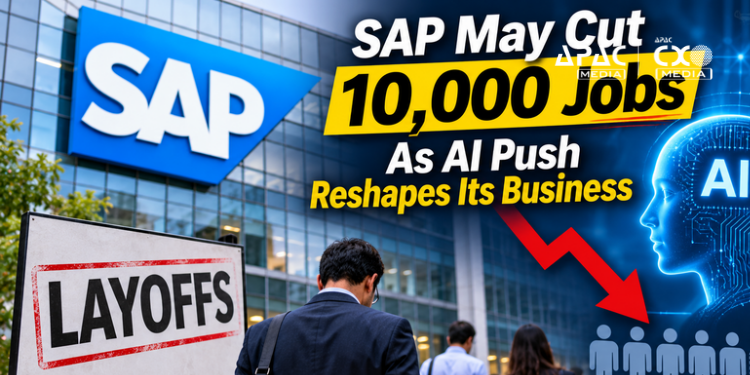
The reported restructuring could affect around 9% of SAP’s global workforce as the German software giant accelerates its AI strategy. The company says no decisions have been made.
28 November 2026
German software giant SAP is preparing for a potential major workforce reduction as artificial intelligence reshapes the enterprise software industry. The reported restructuring could affect at least 10,000 positions, according to Bloomberg, citing people familiar with the discussions.
Reuters separately reported on 27 November that SAP was preparing to cut a sizeable number of jobs. Two people familiar with the matter told the news agency about the potential reductions.
SAP employs approximately 113,000 people worldwide. If the reported 10,000-job figure materializes, the cuts would affect around 9% of its workforce.
However, the company has not confirmed a final restructuring plan or the number of positions that could be affected. SAP says it continuously reviews its organization as the business environment changes through AI. It also said no decisions had been made regarding further measures.
The reports highlight a growing challenge for established enterprise software companies. They must integrate AI into their products while reconsidering the skills, costs, and workforce structures needed to compete.
SAP considers workforce changes as AI strategy accelerates.
SAP develops enterprise software used by large organizations to manage finance, accounting, payroll, procurement, human resources, and other business operations.
Its products support critical business processes across industries. The company is now pushing to integrate artificial intelligence more deeply into its software portfolio.
Chief Executive Christian Klein has made AI a central part of SAP’s strategic direction. The company wants to embed AI capabilities into its applications and help customers automate business workflows.
This transition could change how SAP develops, sells, and supports its products.
AI tools can automate tasks that previously required substantial manual work. They can also change software development, customer support, administration, and internal operations.
For SAP, the challenge is to increase productivity while investing in new capabilities. This could require different skills and fewer resources in some functions.
Bloomberg reported that departments had been asked to identify potential areas for reductions, with product, engineering, and sales among the areas under particular focus. The reported plan remains subject to change and discussions with employee representatives.
SAP says no decisions have been made.
The company has not confirmed the reported 10,000 job cuts.
In a statement reported by media outlets, SAP said it continuously reviews its organization to ensure it remains aligned with its strategy and customer needs.
The company added that roles and functions would naturally change as AI transforms the business environment. It said no decisions had been made regarding further measures and declined to comment on speculation.
Reuters reported that SAP’s works council had not yet been informed about the plans, according to one person familiar with the matter.
This is an important detail because workforce reductions at a large German company involve employee representation and consultation.
The reported figure should therefore not be treated as a final decision. The scale, timing, and affected business areas remain uncertain.
A second major restructuring in two years
The potential cuts would follow SAP’s 2024 transformation program.
In January 2024, SAP announced plans to review approximately 8,000 positions as part of a company-wide restructuring. The program aimed to simplify operations, improve efficiency, and redirect resources towards strategic growth areas, including artificial intelligence.
SAP said most affected positions would be addressed through voluntary leave programs and internal reskilling.
The company also expected to reinvest in areas with stronger growth potential. Consequently, reductions in some business units were offset by recruitment in other areas.
The distinction is important. The 2024 program did not simply represent a permanent reduction in the company's total workforce.
The latest reports suggest a potentially different phase of restructuring. AI is becoming more central to SAP's products and operating model, while management is under pressure to improve efficiency and control costs.
The company may therefore be reassessing which roles and capabilities it needs as its software business evolves.
AI creates pressure across the enterprise software industry.
SAP is not facing this challenge alone.
Enterprise software companies are increasingly integrating generative AI and autonomous agents into products. These technologies can perform tasks involving data analysis, coding, document processing, and business workflow automation.
This creates new opportunities for software providers. However, it also raises questions about traditional software economics and workforce requirements.
AI can reduce the time required to develop certain features and automate parts of internal operations. Companies may therefore reconsider staffing levels, especially in functions where repetitive tasks can be handled by software.
At the same time, AI adoption requires investment in infrastructure, computing capacity, product development, security, and specialist talent.
This creates a complicated financial calculation. Companies must spend on new AI capabilities while finding ways to improve operating efficiency.
SAP has also taken steps to manage AI-related costs. Reuters reported that an SAP executive said the company was replacing some expensive AI models used in its products with cheaper alternatives.
This suggests that cost discipline is becoming an important part of the company's AI strategy.
What the potential cuts mean for SAP employees and customers
For employees, the uncertainty raises questions about future roles, internal transfers, and reskilling opportunities.
SAP has not disclosed which countries or departments would face reductions. It is therefore too early to identify the likely regional impact.
For customers, the more important issue may be how workforce changes affect product development and support.
SAP software is embedded in critical business operations. Customers depend on reliable updates, technical assistance, and long-term product development.
A successful AI transformation could improve these services through faster development and more automated workflows. However, aggressive cost reductions could create operational risks if companies lose experienced employees or reduce essential support capacity.
The company must balance efficiency with the expertise required to maintain complex enterprise systems.
The wider message for the technology workforce
SAP's reported restructuring reflects a wider debate about AI and employment.
Technology companies are increasingly presenting AI as a productivity driver. Yet the financial benefits of automation may also encourage organizations to reduce certain roles and redesign their operating structures.
The impact will not be uniform. Some jobs may disappear, while others will evolve or emerge around AI development, governance, integration, and security.
For large software companies, the transition involves more than introducing AI features. It requires changes to product development, internal operations, and workforce planning.
SAP has not confirmed a new round of job cuts. But the reports show how the AI transition is moving beyond product strategy and into decisions about corporate structure, costs, and employment.
Comments
No comments yet. Be the first to share your thoughts.
Leave a comment