
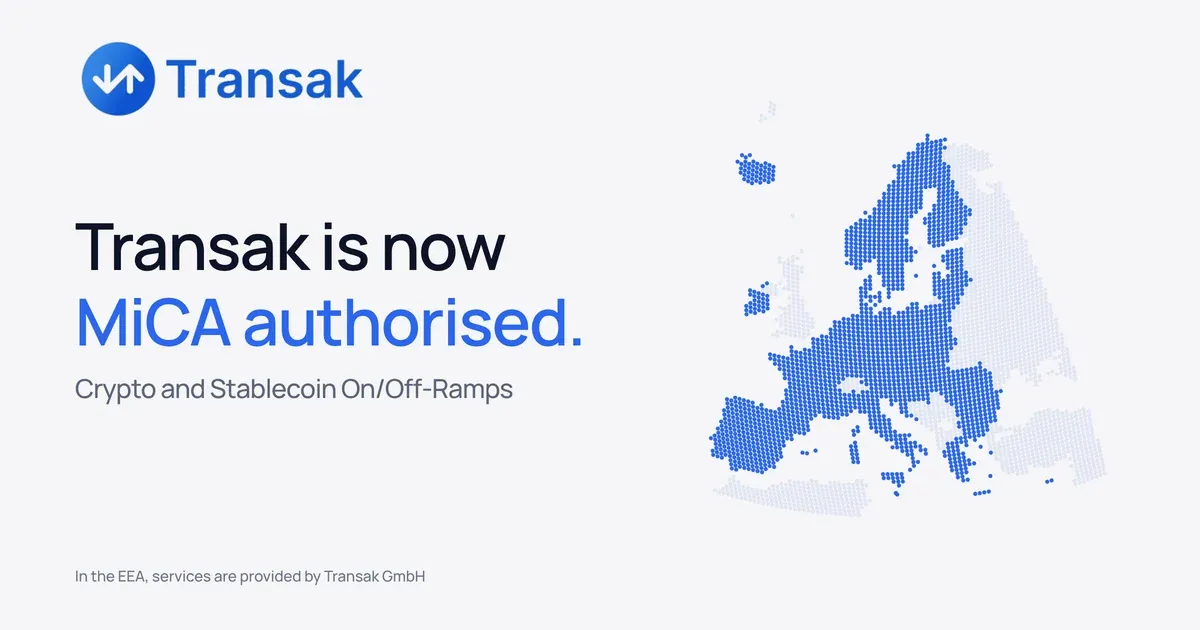
The authorization allows Transak GmbH to provide regulated fiat-to-crypto and crypto-to-fiat exchange services across the European Economic Area through a single integration.
Transak has secured authorization under the European Union's Markets in Crypto-Assets Regulation (MiCA), giving its Austrian entity a regulated route to provide crypto on- and off-ramp services across the European Economic Area (EEA).

The Austrian Financial Market Authority (FMA) authorized Transak GmbH as a crypto-asset service provider (CASP) on 10 November 2026. The company announced the approval on 25 November.
From 26 November, apps integrating Transak can access its regulated services for users across the 30 countries of the EEA, according to the company. The service allows users to buy supported crypto-assets using euros and other supported fiat currencies or sell crypto-assets and receive fiat funds through supported payment methods.
The approval gives wallets, fintechs, exchanges, and other digital platforms access to an authorized European on- and off-ramp provider through one integration.
What Transak's MiCA authorization covers
The FMA authorized Transak GmbH to provide the exchange of crypto-assets for funds under Article 3(1)(16)(c) of MiCA.
This authorization covers the core exchange activity behind Transak's on- and off-ramp services.
Users can purchase supported crypto-assets with fiat currencies through the company's On-Ramp service. Its off-ramp service allows users to sell supported crypto-assets and receive fiat funds.
The distinction matters because the authorization does not automatically cover every type of crypto-asset service. The FMA's published record identifies the exchange of crypto-assets for funds as the authorized service. It should not be interpreted as a general license for custody, portfolio management, or all other activities regulated under MiCA.
Transak GmbH will serve as the group's regulated EEA entity. The company says its European services will operate through this Austrian entity, while other group entities continue to serve markets outside the EEA.
One integration for 30 EEA markets
The authorization allows Transak to use the European regulatory framework to support its services across the EEA.
For fintechs and wallet providers, this could reduce the complexity of establishing separate crypto-to-fiat and fiat-to-crypto arrangements in individual European markets.
Transak says its services will support cards, Apple Pay, Google Pay, and SEPA payments from 26 November. The company also expects additional wallet partners to introduce the service for their European users in the coming weeks.
The model allows partners to integrate Transak's APIs into their own products. Users can then buy or sell supported crypto-assets without necessarily leaving the app or wallet they already use.
This approach could support several use cases, including wallet funding, stablecoin purchases, digital asset withdrawals, and payment services built around crypto balances.
However, access to the service will depend on supported assets, payment methods, partner integrations, and applicable user eligibility requirements.
Native Ramps brings crypto transactions into apps
The MiCA authorization also supports Transak's push to expand its Native Ramps offering.
Native Ramps are APIs designed to let platforms embed crypto on- and off-ramp functionality directly into their own interfaces. Users can complete supported transactions within the partner's app instead of being redirected to a separate third-party experience.
Transak says MetaMask introduced its Native Ramps integration in 2025. Other partners have since followed.
For digital wallets and fintech applications, embedded payment flows can reduce friction during onboarding and funding. They can also help platforms maintain a more consistent customer experience.
The regulatory approval adds an important layer to this model. European partners can integrate the services with Transak GmbH as their authorized provider for the relevant EEA exchange activities.
Sami Start, co-founder and CEO of Transak, said the MiCA framework provides greater clarity for companies developing products that use stablecoins.
He added that the company plans to continue building products for partners serving users across Europe and other international markets.
Building a wider regulated payments network
Transak says the Austrian authorization adds to its regulatory presence in markets including the United States, the United Kingdom, Canada, and Australia.
The company operates through separate group entities and local arrangements in different jurisdictions. Its approach is to connect local banking rails and payment methods with crypto infrastructure through a common integration layer.
Transak says more than 600 apps and over 10 million users already rely on its services globally.
Its European press materials also report more than 100 app integrations and over 300,000 users in the EEA. These are company-reported figures.
The expansion comes as stablecoins gain a larger role in digital payments, treasury operations, and financial applications. However, businesses building these services still need reliable connections between blockchain-based assets and traditional banking systems.
Regulatory authorization, local payment access, and compliance processes are therefore important parts of the infrastructure.
What the license means for Europe's crypto market
Transak's authorization highlights how MiCA is reshaping the operating environment for crypto service providers in Europe.
The framework creates a common regulatory structure for authorized crypto-asset service providers. It also allows eligible firms to provide authorised services across the EEA through passporting arrangements.
For platforms operating across multiple countries, this can offer a more consistent route to market than relying on separate national arrangements.
Still, the license does not remove all operational or regulatory requirements. Providers must continue to meet applicable obligations, while partner platforms remain responsible for their own activities and regulatory responsibilities.
For Transak, the immediate opportunity is to expand access to regulated fiat and crypto exchange services through existing wallet and fintech integrations.
The next stage will depend on how quickly partners activate the service, which assets and payment methods become available, and how effectively Transak scales its European banking connections.
Comments
No comments yet. Be the first to share your thoughts.
Leave a comment