
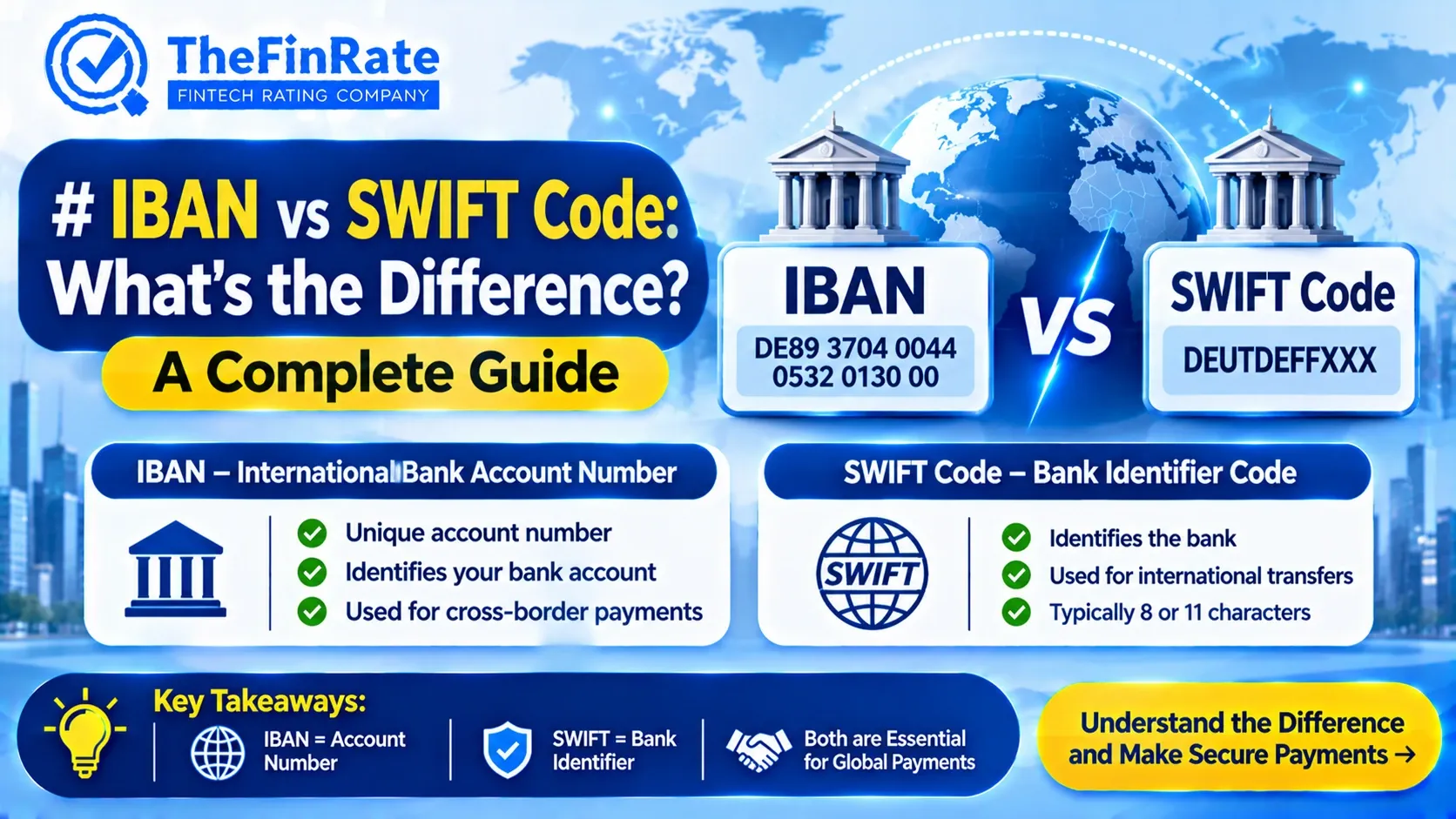
International money transfers require accurate banking information to ensure that funds reach the correct destination. When sending or receiving money across borders, banks may ask for details such as an IBAN, SWIFT code, or BIC. Although these terms are often used together, they serve different purposes in the international banking system.
Understanding IBAN vs SWIFT code is important for individuals, businesses, freelancers, exporters, and companies that regularly make or receive international payments. Providing incorrect banking details can delay transactions, create additional charges, or result in rejected transfers.
An IBAN identifies a specific bank account, while a SWIFT/BIC code identifies the bank or financial institution. Depending on the destination country and payment method, an international transfer may require one or both.
In this guide, we explain how IBAN and SWIFT codes work, their key differences, and when you need them for international payments.
What Is an IBAN?
IBAN stands for International Bank Account Number. It is an internationally standardized format used to identify individual bank accounts when processing domestic and cross-border payments in countries that have adopted the IBAN system.
An IBAN helps financial institutions identify the destination account and process payments more accurately. It combines country-specific banking information with account identification details.
According to the ISO 13616 standard, an IBAN can contain up to 34 alphanumeric characters, depending on the country's format.
Structure of an IBAN
An IBAN generally contains three main elements:
- Country code: Two letters identifying the country where the account is held.
- Check digits: Two numbers used to help validate the IBAN.
- Basic Bank Account Number (BBAN): Country-specific information that includes the domestic bank and account identification details.
For example, a fictional IBAN might look like this:
GB29 NWBK 6016 1331 9268 19
This example illustrates a UK-style IBAN format. It should not be used as actual payment information.
Why Is an IBAN Important?
IBANs help reduce errors when processing international payments. Their standardized structure makes it easier for financial institutions to identify the correct destination account.
Key benefits include:
- More consistent account identification
- Support for automated payment processing
- Reduced risk of incorrect account details
- Easier processing of eligible cross-border transfers
- Support for international banking operations
Businesses receiving payments from overseas customers may need to provide their IBAN when operating in countries that use this system.
What Is a SWIFT Code?
A SWIFT code is an international identifier used to identify a bank or financial institution during financial transactions. It is commonly known as a BIC, which stands for Business Identifier Code.
SWIFT stands for the Society for Worldwide Interbank Financial Telecommunication, an organization that operates a global financial messaging network used by banks and other financial institutions.
A SWIFT/BIC code helps identify the institution involved in an international payment so that financial messages can be directed appropriately.
Structure of a SWIFT Code
A SWIFT/BIC code usually contains either 8 or 11 alphanumeric characters.
Its structure includes:
- Bank code: Four characters identifying the institution.
- Country code: Two letters identifying the country.
- Location code: Two characters identifying the location.
- Branch code: Three optional characters identifying a particular branch or unit.
For example, a fictional SWIFT/BIC format could look like:
ABCDUS12XXX
This is an illustrative format, not a verified bank code.
Why Is a SWIFT Code Important?
SWIFT/BIC codes help financial institutions identify the correct bank when processing international transfers.
Their key benefits include:
- Identifying banks internationally
- Supporting cross-border payment routing
- Reducing errors in bank identification
- Supporting international financial messaging
- Helping banks coordinate payment instructions
Businesses that regularly send or receive international payments should confirm the correct SWIFT/BIC details with their banks.
IBAN vs SWIFT Code: Key Differences
Although IBAN and SWIFT codes are both used in international banking, they identify different things.
|
Comparison |
IBAN |
SWIFT/BIC Code |
|---|---|---|
|
Full form |
International Bank Account Number |
Business Identifier Code |
|
Main purpose |
Identifies a specific bank account |
Identifies a bank or financial institution |
|
Format |
Country-specific, up to 34 characters |
Usually 8 or 11 characters |
|
Structure |
Country code, check digits, and BBAN |
Bank, country, location, and optional branch code |
|
Primary role |
Account identification |
Bank identification |
|
Usage |
Countries that have adopted IBAN |
International financial messaging and bank identification |
|
Interchangeable? |
No |
No |
The simplest way to remember the difference is that an IBAN identifies where the money should be credited within a banking institution, while a SWIFT/BIC code identifies which financial institution is involved.
Do You Need Both IBAN and SWIFT Codes for International Transfers?
Not every international payment requires both details. The information required depends on the destination country, payment currency, sending bank, and transfer method.
Here are some common situations:
1. Sending Money to an IBAN Country
If you are sending money to a bank account in a country that uses IBAN, the recipient's IBAN will generally be required.
A SWIFT/BIC code may also be requested, depending on the payment route and the sending bank's requirements.
2. Sending Money Through the SEPA Network
The Single Euro Payments Area (SEPA) supports euro payments between participating countries and territories.
For many standard SEPA credit transfers, the IBAN is sufficient for identifying the beneficiary account. The payment provider or bank may handle other routing information automatically.
3. Sending Money to a Non-IBAN Country
Some countries do not use the IBAN system. In these cases, banks generally rely on local account details and appropriate routing identifiers.
For example, international transfers to India may require the beneficiary's account number, bank name, SWIFT/BIC code, and other details requested by the receiving bank.
Businesses should always follow the instructions provided by the receiving financial institution.
Does India Use IBAN or SWIFT Codes?
India does not use the standard IBAN system for its banking accounts. Indian banks generally use account numbers and IFSC codes for domestic transfers, while SWIFT/BIC codes are used for international bank transfers.
Understanding the difference between these identifiers is especially important for Indian businesses receiving payments from overseas clients.
What Is IFSC?
IFSC stands for Indian Financial System Code. It is an 11-character alphanumeric identifier used to identify bank branches participating in India's NEFT payment system.
IFSC is commonly used for domestic transfers through NEFT, RTGS, and IMPS, according to the applicable payment system requirements.
What Details Are Needed to Receive International Payments in India?
An overseas sender may be asked to provide the following information:
- Beneficiary's full name
- Indian bank account number
- Bank name
- Bank branch details and address
- Bank's SWIFT/BIC code
- IFSC code, when requested
- Payment purpose or other remittance information, where applicable
The exact requirements depend on the receiving bank, sending bank, currency, and transfer route.
Important: If an overseas payment form asks for an IBAN but the recipient has an Indian bank account, do not create or guess an IBAN. Ask the sending bank how to enter the Indian account number and SWIFT/BIC details using its non-IBAN transfer option.
How to Find Your IBAN and SWIFT Code
Finding the correct banking details is important before initiating an international transfer.
How to Find Your IBAN
If your bank operates in an IBAN country, you can usually find your IBAN through:
- Your online banking account
- Your mobile banking application
- Bank account statements
- Official bank documents
- Your bank's customer support team
Always copy the complete IBAN exactly as provided by your bank.
How to Find Your SWIFT/BIC Code
You can generally find your SWIFT/BIC code through:
- Your bank's official website
- Your bank's mobile application
- Account statements or international transfer instructions
- Customer support
- The official SWIFT BIC directory
Do not rely on unverified codes found on random websites. Confirm the code with your bank before sending money.
Common Mistakes to Avoid When Using IBAN and SWIFT Codes
Incorrect banking details can delay international payments. Businesses and individuals should avoid these common mistakes.
1. Confusing IBAN With SWIFT
An IBAN identifies an account, whereas a SWIFT/BIC code identifies a financial institution. They serve different functions and cannot replace one another.
2. Entering an Incorrect Country Code
The first two characters of an IBAN identify the country. Entering the wrong country code can cause validation errors or payment problems.
3. Using an Outdated SWIFT Code
Banks may have different SWIFT/BIC codes for different branches or operations. Always confirm the correct code before making a transfer.
4. Ignoring Additional Bank Details
Some transfers require information beyond an IBAN or SWIFT code, such as beneficiary address, local routing codes, or intermediary bank details.
5. Sharing Incorrect Beneficiary Information
The beneficiary's account name and account details should match the receiving bank's records. Incorrect information may result in delays or rejected payments.
How IBAN and SWIFT Support Cross-Border Payments
International payments involve several financial institutions, payment networks, and compliance checks. Accurate banking identifiers help these institutions process transactions more efficiently.
IBAN helps identify the destination account, while SWIFT/BIC helps identify financial institutions involved in the payment process.
Together with other banking and payment infrastructure, these standards support international transfers for:
- International trade
- Overseas supplier payments
- Freelancer and contractor payments
- Global business transactions
- International salary payments
- Cross-border ecommerce settlements
For businesses expanding internationally, choosing suitable IBAN account solutions and understanding different payment providers can help simplify international payment operations.
Frequently Asked Questions
- Is an IBAN the same as a SWIFT code?
No. An IBAN identifies a specific bank account, while a SWIFT/BIC code identifies a bank or financial institution. Both may be required for international transfers, depending on the destination and payment route.
- Is BIC the same as a SWIFT code?
In everyday banking, the terms SWIFT code and BIC are generally used interchangeably. BIC is the standardized identifier under ISO 9362, and SWIFT serves as its registration authority. However, not every BIC is necessarily connected to the SWIFT financial messaging network.
- Can I transfer money using only a SWIFT code?
A SWIFT/BIC code identifies the receiving bank, not the recipient's individual account. You will generally also need an account number or IBAN, depending on the destination country's banking system.
- Can I receive international payments in India without an IBAN?
Yes. Indian banks do not generally use IBANs. International transfers to Indian accounts typically use the beneficiary's bank account number and SWIFT/BIC details, along with other information requested by the receiving bank.
- How many characters are in an IBAN?
An IBAN can contain up to 34 alphanumeric characters. Its exact length depends on the country.
- How many characters are in a SWIFT code?
A SWIFT/BIC code generally contains either 8 or 11 characters. The final three characters are optional and can identify a branch or organizational unit.
- Does every country use IBAN?
No. IBAN is used by countries that have adopted the ISO 13616 standard. Other countries use their own account numbering and bank identification systems.
- Can I find my IBAN using my account number?
You should not assume that a domestic account number can be converted into an IBAN. In countries that use IBAN, the bank provides the correct standardized account identifier. Contact your bank if you cannot find it.
Conclusion
Understanding IBAN vs SWIFT code is essential for anyone sending or receiving money internationally. Although both are important banking identifiers, they serve different purposes. IBAN identifies an individual bank account, while SWIFT/BIC identifies the financial institution involved in the transfer.
For international transactions, always check the banking requirements of the destination country and confirm the details directly with the relevant bank. Businesses handling cross-border payments should also understand local banking identifiers, intermediary bank requirements, settlement processes, and payment provider fees.
Explore TheFinRate to discover IBAN account solutions, payment providers, and financial services that support international business payments.
Comments
No comments yet. Be the first to share your thoughts.
Leave a comment