
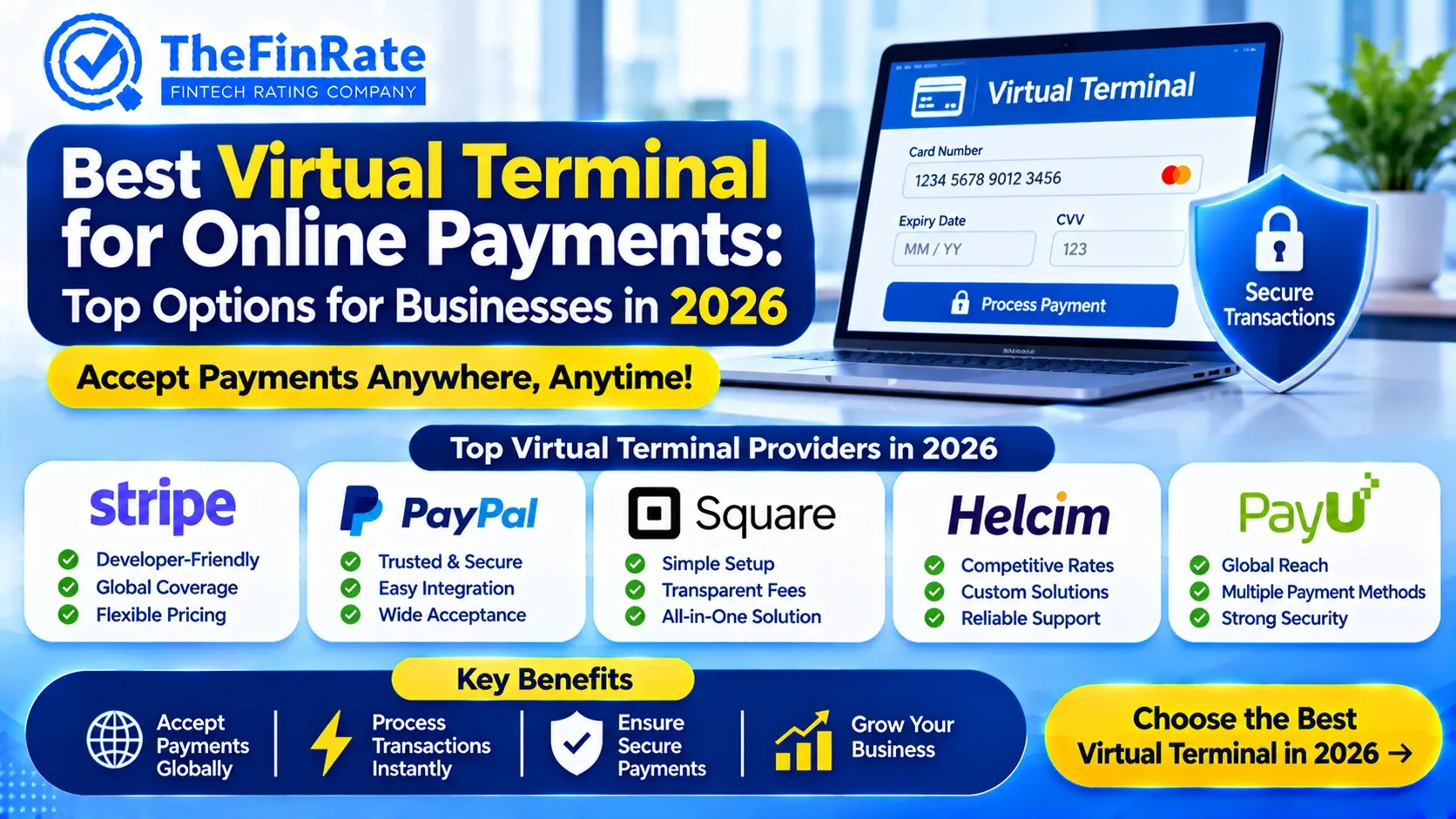
Businesses need flexible ways to accept payments from customers who cannot visit a physical store or complete a traditional website checkout. A virtual terminal makes this possible by allowing businesses to process card payments through a secure web-based interface. It is particularly useful for phone orders, remote billing, service payments, deposits, and business-to-business transactions.
Choosing the best virtual terminal for online payments depends on your transaction volume, payment methods, processing fees, security requirements, and business model. Some platforms are designed for small businesses, while others offer advanced features for larger companies and high-risk merchants.
In this guide, we explore leading virtual terminal providers, their features, and the factors businesses should consider before selecting a payment solution.
What Is a Virtual Terminal?
A virtual terminal is a browser-based payment processing tool that allows businesses to accept payments without using a physical card machine. Instead of customers entering their card details at a checkout page, an authorized employee enters the payment information into a secure online interface.
For example, a customer may call a company to purchase a service. The employee can open the virtual terminal, enter the customer's card details, and submit the transaction for processing.
Virtual terminals are commonly used for:
- Telephone and mail-order payments
- Remote customer billing
- Deposits and service payments
- Business-to-business transactions
- Recurring and scheduled payments
- Taking payments when a customer cannot use an online checkout
A virtual terminal is different from a payment gateway. A gateway generally enables customers to enter their own payment details through a website or application, while a virtual terminal allows authorized staff to process payments manually.
Businesses exploring these options can also review TheFinRate's payment gateway directory to understand the wider payment processing ecosystem.
Best Virtual Terminals for Online Payments in 2026
The following providers offer different approaches to remote payment acceptance. They are not presented as a universal ranking; the right choice depends on your location, eligibility, transaction volume, and business requirements.
1. Authorize.net
Authorize.net is a payment platform that supports businesses accepting payments online and through manually entered transactions. Its virtual terminal capabilities make it relevant for companies that handle phone orders, customer billing, and recurring payments.
Key features:
- Virtual terminal for manually entered payments
- Recurring and scheduled billing options
- Fraud detection tools
- Payment reporting and transaction management
- Integration capabilities for business systems
Best for: Established businesses looking for a payment platform with virtual terminal and broader payment management features.
2. Helcim
Helcim offers payment processing tools for businesses that want to manage in-person, online, and manually entered payments. Its virtual terminal can support remote transactions alongside invoicing and recurring billing.
Key features:
- Browser-based virtual terminal
- Card and ACH payment support
- Invoicing and recurring billing
- Customer management tools
- Interchange-plus pricing model
Best for: Small and growing businesses that want multiple payment options in one platform.
3. Square
Square provides payment solutions for small businesses, retailers, service providers, and other merchants. Its payment tools can help businesses accept remote payments and manage transactions through a connected business platform.
Key features:
- Online payment acceptance
- Remote payment processing options
- Invoicing capabilities
- Transaction reporting
- Integration with other Square business tools
Best for: Small businesses that value straightforward payment management and an integrated business platform.
4. PayPal
PayPal is widely used for digital payments and offers solutions for businesses that need to collect payments remotely. Its Virtual Terminal service supports manually entered card transactions, subject to account eligibility and regional availability.
Key features:
- Remote card payment acceptance
- Support for multiple currencies in eligible services
- Payment tracking
- Integration with PayPal business services
- Options for online checkout and invoicing
Best for: Businesses already using PayPal or those that need a familiar payment brand for remote transactions.
5. Stax
Stax offers payment processing services designed for businesses with regular or higher transaction volumes. Its payment tools include virtual terminal functionality and options for managing customer payments.
Key features:
- Virtual terminal payment acceptance
- Recurring payment capabilities
- Customer and transaction management
- Reporting tools
- Subscription-based pricing options
Best for: Established businesses that process consistent payment volumes and want to evaluate subscription-style pricing.
6. PaymentCloud
PaymentCloud works with businesses that may face additional underwriting requirements, including merchants in certain high-risk industries. Its solutions can include virtual terminal access and payment processing support based on the merchant's approved account and provider arrangement.
Key features:
- Merchant account solutions
- Support for selected high-risk industries
- Remote and manually entered payment options
- Payment gateway flexibility
- Chargeback and risk-management support options
Best for: Businesses that need specialist merchant account support or have difficulty qualifying with mainstream payment providers.
7. NMI
NMI provides payment gateway technology that supports businesses, payment service providers, and integrated payment platforms. Its capabilities can be used to manage transactions across online, in-person, and virtual terminal environments, depending on the configuration.
Key features:
- Payment gateway technology
- Virtual terminal capabilities
- Recurring payment support
- Payment integrations
- Transaction management tools
Best for: Payment providers, software platforms, and businesses that need flexible payment technology and integrations.
8. EBizCharge
EBizCharge offers payment processing technology for businesses that want to connect payments with accounting, enterprise resource planning, and customer management workflows.
Key features:
- Browser-based virtual terminal
- Invoice payment processing
- Recurring payment options
- Customer payment management
- Accounting and business software integrations
Best for: B2B companies and businesses that want to connect payment processing with their existing financial workflows.
Comparison of Virtual Terminal Providers
|
Provider |
Main use case |
Features to evaluate |
|---|---|---|
|
Authorize.net |
Established businesses |
Recurring billing, fraud tools, reporting |
|
Helcim |
Growing businesses |
ACH, invoicing, pricing model |
|
Square |
Small businesses |
Remote payments, invoicing, integrations |
|
PayPal |
Remote and international payments |
Currency support, account eligibility |
|
Stax |
Higher-volume businesses |
Subscription pricing, recurring payments |
|
PaymentCloud |
High-risk merchants |
Underwriting, gateway flexibility |
|
NMI |
Payment platforms and integrations |
Gateway technology, recurring payments |
|
EBizCharge |
B2B payment workflows |
Invoicing, accounting integrations |
Features, availability, pricing, and eligibility can change by country and merchant agreement. Always confirm current terms directly with the provider before making a decision.
Benefits of Using a Virtual Terminal for Online Payments
1. Accept Payments Remotely
A virtual terminal allows businesses to accept payments without requiring customers to visit a physical location. This is useful for service providers, consultants, wholesalers, and companies that take orders over the phone.
2. Support Different Payment Workflows
Businesses can use virtual terminals for deposits, invoices, one-time charges, and eligible recurring transactions. This flexibility can simplify payment collection across different customer interactions.
3. Improve Payment Management
Many virtual terminal platforms include transaction records, customer details, reporting, and refund tools. These features help businesses monitor payments and organize their financial operations.
4. Support Business Growth
As transaction volumes increase, companies may need additional payment methods, integrations, and reporting capabilities. Choosing a scalable solution can reduce the need to replace payment technology as the business grows.
5. Reduce Manual Payment Administration
When integrated with invoicing, accounting, or customer management software, a virtual terminal can help reduce repetitive administrative work and improve payment tracking.
How to Choose the Best Virtual Terminal
Selecting a virtual terminal requires more than comparing advertised processing rates. Businesses should evaluate the complete service and its suitability for their payment workflows.
Processing Fees and Monthly Costs
Review transaction fees, monthly charges, gateway costs, setup fees, chargeback fees, and any additional service expenses. Manually entered card transactions may have different pricing from card-present transactions or standard website checkout payments.
Payment Methods
Check whether the provider supports the payment methods your customers use. Depending on your business, you may need credit and debit cards, ACH transfers, or other payment options.
Security and PCI Compliance
Payment security is essential when handling customer card information. Look for secure data transmission, access controls, fraud monitoring, and tokenization where supported. Understand your PCI DSS responsibilities and never store sensitive card details in unsecured documents, email, or spreadsheets.
Integration Capabilities
A virtual terminal should work with the systems your business already uses. Consider integrations with accounting software, CRM platforms, invoicing tools, ecommerce systems, and payment gateways.
Industry and Merchant Account Eligibility
Not every provider accepts every business type. High-risk merchants should confirm underwriting requirements, supported industries, processing limits, reserve policies, and chargeback procedures before applying.
Businesses comparing providers can explore merchant account providers and read independent payment gateway reviews before making a decision.
Virtual Terminal vs. Online Payment Gateway
Although both solutions support remote payments, they serve different purposes.
|
Feature |
Virtual Terminal |
Payment Gateway |
|---|---|---|
|
Payment entry |
Usually entered by authorized staff |
Usually entered by the customer |
|
Main purpose |
Phone orders and remote billing |
Website and app checkout |
|
Customer interaction |
Customer may provide details by phone |
Customer completes an online checkout |
|
Common users |
Service businesses and B2B companies |
Ecommerce stores and online platforms |
|
Typical setup |
Browser-based payment interface |
Website, app, or checkout integration |
A business that regularly accepts phone orders may benefit from a virtual terminal. An ecommerce company that allows customers to purchase products directly through its website will generally need a payment gateway. Some businesses use both to support different customer payment preferences.
Frequently Asked Questions
- What is the best virtual terminal for online payments?
The best option depends on your business requirements. Authorize.net offers broader payment management capabilities, Helcim is worth evaluating for growing businesses, Square serves many small-business workflows, and PaymentCloud may suit eligible high-risk merchants.
- Can I accept credit card payments without a physical terminal?
Yes. A virtual terminal allows authorized employees to enter customer card details through a secure online interface. A physical card machine is not required for these manually entered transactions.
- Are virtual terminals safe to use?
Virtual terminals can provide secure payment processing when supported by appropriate security controls and used correctly. Businesses should follow PCI DSS requirements, restrict employee access, and avoid storing sensitive card information outside approved systems.
- Do virtual terminals support recurring payments?
Some virtual terminal providers offer recurring billing or card-on-file functionality. Availability depends on the provider, account configuration, customer authorization, and applicable rules.
- Is a virtual terminal the same as a payment gateway?
No. A virtual terminal is generally used by a merchant or employee to enter payment details, while a payment gateway enables customers to submit payment information through a website or application.
- Can high-risk businesses use virtual terminals?
Some providers support eligible high-risk businesses, but approval depends on the industry, transaction history, business model, and underwriting requirements. Merchants should confirm industry acceptance before applying.
Conclusion
Choosing the best virtual terminal for online payments can help businesses manage remote transactions, collect customer payments, and simplify billing operations. Providers such as Authorize.net, Helcim, Square, PayPal, Stax, PaymentCloud, NMI, and EBizCharge offer different capabilities for businesses with different needs.
Before selecting a provider, compare processing costs, payment methods, security features, integrations, merchant account requirements, and customer support. The right solution should fit your current payment workflow while supporting your business as it grows.
Explore TheFinRate to compare payment providers and discover payment solutions that match your business requirements.
Comments
No comments yet. Be the first to share your thoughts.
Leave a comment